On Travis Scott
I remember my first exposure to Travis Scott like it was yesterday. I was on a rap blog one day in 2012 and during my usual scroll and click adventure I saw a post for a song called Animal by a rapper named Travi$ Scott featuring… TI??? His stage name struck me as the usual kind that the Hipster Rapper Of The Day usually would have but here was a complete unknown. With a TI verse. How?! Either way, I wasn’t very into the song but I was still intrigued enough to check him out. His other offerings grabbed me immediately. Somehow this guy had a song produced by current Hot Go-To Producer, Lex Luger. It all seemed so strange. How does this random new rapper have these contacts? His come-up, like so many early 2010s rappers, felt shady and mysterious but his was especially shady with (completely unaddressed by him, of course) rumors of betraying friends, stealing beats and even sexual assault surrounding him before he was even very popular. I found myself already prepared very early on for a moment when he was confirmed to have crossed the Safe To Consume line one day. Regardless, from that point onward I began my years long fandom of Travis Scott’s music.
The early material was at once very of its time yet ahead of its time as no one else at that moment had polished this sound that became so widespread later. I was hooked but at that same time I knew to hold on to the feeling. I knew that he would soon abandon at least a few of the traits that made his music sound so special. This was before he started to lean on robotic, heavily autotuned singing; at this time he mostly rapped with a gritty voice that had an audible smile and a slight lisp. He frequently had moments in songs with wordlessly crooned background harmonies that I found myself seeking back to repeatedly on each listen (My favorite examples being this one, this one and this one) which was the one thing I knew would definitely go and would be the biggest pity to see gone. Melodic parts used effects like pitch shifting or chorus, but rarely overtly applied autotune. There was a homespun yet expansive and grandiose feel to every song, one that he later attempts to emulate with songs that are simply not mixed properly. Of course, there were things he kept: His cheeky (and very corny) sense of humor, love of distorted overblown 808 bass as the focus of the instrumental, the psychedelic dark atmosphere and tendency toward songs that change shape mid-song (for example, this song that sounds like a wobbly first attempt at his Two Songs For The Price Of One) remained. Despite that, I still found myself loving the albums he has released since those early days, Astroworld actually being among my favorite albums and whatever album he released was likely to be my favorite Hip-Hop release that year (Birds in the Trap Sing McKnight was somewhat weak but would’ve lost to Danny Brown’s Atrocity Exhibition regardless. That’s a good album). That is, until recently.
From 2012 until 2021, he was more often than not my favorite rapper. Yep. As a rapper! He’s a very skilled rapper in a technical sense: nimble with flows, great sense of dynamics, capable of dense rhyme patterns, excellent sense of rhythm, never overstuffs bars or leaves awkward empty spots, has a sense of melody that goes beyond the usual three note major intervals that most melodic rappers employ. But that doesn’t matter much for many listeners because all those skillfully performed bars are so devoid of substance it all fails to connect with the audience. I personally don’t expect introspection out of rappers and usually roll my eyes when reviews of rap albums bring it up as something they were looking for or are docking points for lacking it. However, the issue is that even when the subject matter is shallow, it is still important to flesh out the scene that is being set. Sometimes Travis does decide to open the curtain just a little but he still doesn’t paint a single clear picture with his words. Something as simple as a party or as potentially deep as his origin story will be hidden behind a wall of noncommittal wording and abrupt subject changes, opting instead to refuse to show emotion or provide anything even resembling a window into who the man behind the vibes is. Which is a shame because the things he hints at actually seem like they’d make for very interesting lyrics if he bothered.
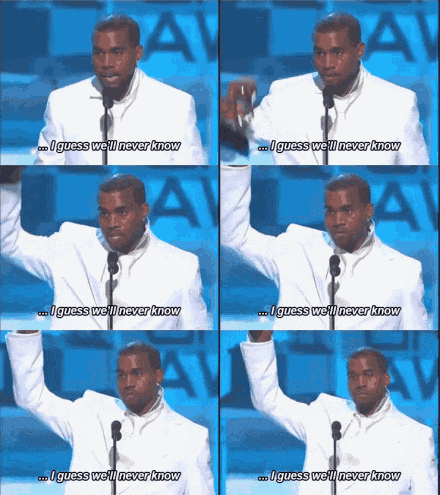
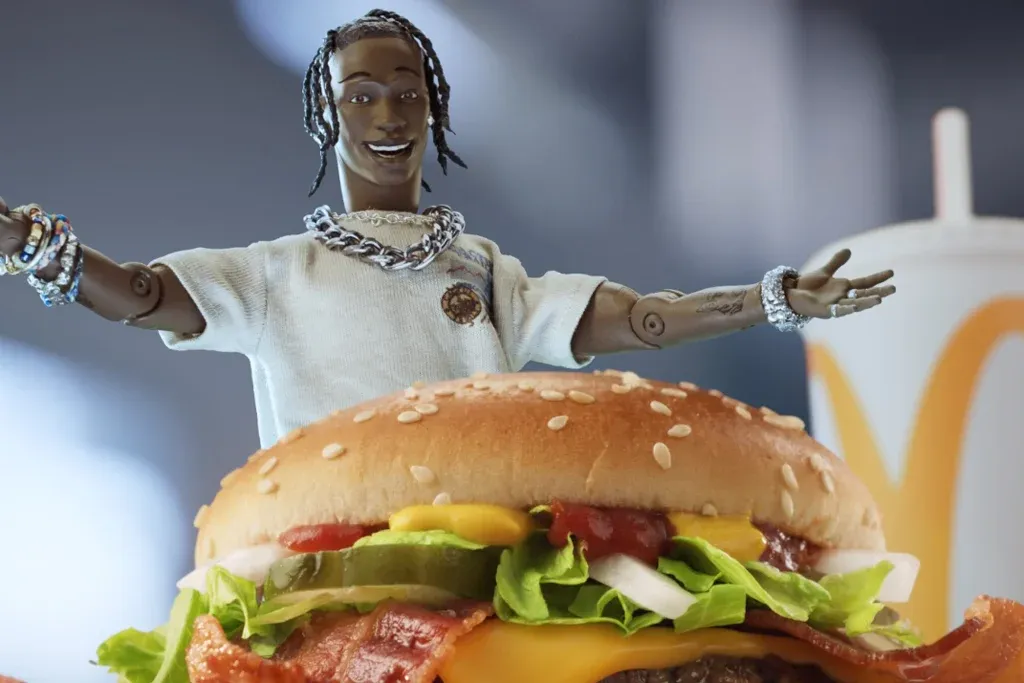
He has, in many ways, become the action figure on the Rodeo album cover. A “brand” more than a person. A “ringmaster” more than the main attraction himself. Basically, not only is a featureless Travis Scott album not something his audience would particularly want, it’s something he is highly unlikely to do at this point. He puts the shit together, he’s the glue. (Ironically, speaking of that song, I actually usually turn Sicko Mode off once the second Drake verse starts. I am that one person who actually was listening to the Travis Scott album for the Travis Scott. His part is better. I will accept no other arguments.) An auteur role very similar to the one his idol, Kanye West had taken on ever since 2010 where each album is a Capital-E Event featuring as many big names as he can fit into an hour. Of course this garners many comparisons, especially now that he’s at the point where the features have become part of the hype itself upon release. A funny twist considering one thing, when I very first heard Yeezus I thought a few times through that initial listen: This sounds like Travis Scott. Shrieks, shouts, fuzzy 808 bass, dark industrial-like atmosphere, ramped up corny misogynistic one-liners, huge pitched down snares, pitched down doubled vocals and songs alternating between skeletal and baroque at the drop of a hat were hallmarks of what I had heard for the past year as the Travis Scott Sound. I saw it as a case of the mentee influencing the mentor as was the case with Trent Reznor and David Bowie. With that being said; for an artist who started out very much in the mold of his idols (Kid Cudi and the aforementioned Kanye West), it was a shame to see how much he had left a lot of his more unique quirks and traits behind once he reached megastar status.
Just as the story goes for many of his peers from the time when he was a rising star, maybe this is a story of a rapper whose finest work likely sits somewhere on a hard drive, kept from our ears a decade ago by record label red tape. A rapper whose most interesting available music is sitting in obscurity, sitting somewhere in the depths of YouTube and SoundCloud for only early adopters and die-hards to hear. Otherwise the average observer and even fan is left to only hear what we have right now: routine, simplified melodies and rapping on a bloated album featuring a bloated single featuring fellow megastars Bad Bunny and The Weeknd. Called…K-POP. A move perfect for a man with a Kardashian-Jenner child. One who has done a concert in Fortnite. One who has the kind of pull that he actually could hold a concert big enough for a crowd crush like the one that tragically occurred at his Astroworld concert, then get away with never fully addressing that either. Travis Scott is a fascinating subject to me not just because of the great music he has released or even the influence that music has had on me as a musician but most of all because he is what could possibly be the last true Rap Superstar. I watched him go from having views totaling in the tens of thousands to people being sick of hearing Goosebumps, and after that, Sicko Mode. And even more so at that! From underrated to oversaturated over a span of just five years. But what could’ve been if the kid who made that stew of Southern Hip-Hop, Indie Rock and sprinkles of Industrial would’ve gotten that chance to release an actual album? What if those loosies could’ve actually been part of a project? Will he ever know that his natural voice and his face don’t need to constantly need to be obscured? What WAS the “Illemerica” thing he was always shouting out on old songs and even has an old unreleased song named after anyway?! To quote his mentor…